
Introduction
Why do 73% of IPTV service providers experience unexpected stream failures during peak traffic hours? The answer often lies not in bandwidth limitations or server capacity, but in the foundational encoding infrastructure that most operators overlook until disaster strikes.
An IPTV Encoder Box is not just another piece of hardware in your streaming stack—it’s the critical conversion point where raw video signals transform into optimized IP streams capable of reaching thousands of viewers simultaneously. Yet many IPTV resellers, platform owners, and broadcasters make encoding decisions based on incomplete information, focusing solely on upfront costs while ignoring downstream impact on viewer retention, scalability, and operational stability.
The IPTV market is projected to surpass $140 billion by 2028, driven by increasing demand for live streaming in hospitality, corporate communications, worship services, and OTT platforms. As delivery complexity grows with multi-bitrate requirements, CDN integration, and diverse device ecosystems, the strategic role of professional encoding hardware becomes paramount. Cloud encoding services promise simplicity, but they introduce latency variability, unpredictable costs, and limited control that can cripple mission-critical broadcasts.
This guide delivers 11 actionable insights on IPTV Encoder Box deployment, optimization, and strategic planning. Whether you’re scaling from a single channel to hundreds, integrating with IPTV middleware, or protecting streams from unauthorized access, these insights address real-world challenges that separate failing IPTV operations from thriving ones.
The Strategic Role of an IPTV Encoder Box in End-to-End Delivery
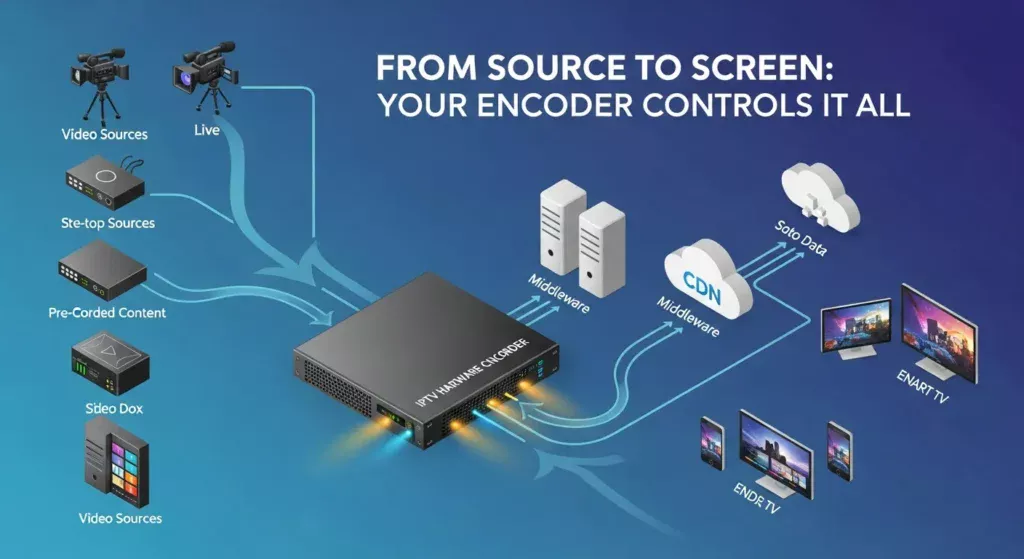
Understanding where an IPTV Encoder Box fits within your complete IPTV infrastructure reveals why encoding decisions ripple through every aspect of service quality. The encoder sits at the origin point of your delivery chain—receiving raw HDMI, SDI, or composite video inputs and outputting protocol-formatted streams (RTMP, UDP multicast, HLS, MPEG-TS) that your middleware, servers, and CDN distribute to end users.
Unlike cloud encoding services that introduce internet upload dependency and variable processing delays, a professional encoder box provides deterministic performance. When live broadcasts cannot tolerate 5-10 second cloud encoding latency, on-premises hardware encoding becomes non-negotiable. The encoder’s output quality, bitrate stability, and format compatibility directly determine whether your IPTV middleware can reliably distribute streams without buffering or degradation.
Strategic encoding decisions affect your entire business model. Choosing H.265/HEVC compression over H.264 can reduce bandwidth costs by 40-50% while maintaining visual quality, directly impacting monthly CDN expenses and enabling more channels within existing infrastructure. For IPTV resellers, encoder reliability translates to customer retention—stable encoding generates predictable revenue streams, while unstable encoding leads to support tickets, churn, and reputation damage.
IPTV Encoder Box vs Cloud & Software Encoding Services
The cloud encoding versus hardware debate often oversimplifies into cost comparisons, ignoring critical operational differences. Cloud encoding introduces unavoidable internet upload latency—typically 5-15 seconds even with optimal connectivity—making it unsuitable for live events requiring real-time interaction. Worship services with live feedback loops, sports bars showing games with audience reactions, or corporate town halls requiring immediate Q&A cannot absorb this delay.
Cost predictability separates hardware from cloud services. An IPTV Encoder Box requires upfront capital expenditure but operates with fixed costs—power consumption averaging 20-40 watts and minimal maintenance. Cloud encoding bills per processing hour or output gigabyte, creating variable monthly expenses that spike during high-traffic events. For broadcasters running 24/7 channels, cloud services costing $0.02-0.05 per output minute accumulate to thousands monthly, exceeding hardware ROI within 6-12 months.
Control and customization favor dedicated hardware. Professional encoder boxes allow granular configuration of GOP structure, frame intervals, and bitrate allocation that cloud platforms restrict to preset profiles. When IPTV platform owners need to optimize specific content types—such as low-motion presentations requiring lower bitrates or high-motion sports demanding increased frame rates—hardware encoders provide flexibility cloud services cannot match without custom enterprise contracts. Software encoding on general-purpose servers represents a middle ground but inherits CPU resource competition issues, degrading both encoding and IPTV middleware during peak load.
Scalability patterns differ fundamentally between approaches. Cloud encoding scales horizontally by purchasing more processing capacity, suitable for unpredictable workloads. IPTV operations with known channel counts benefit from vertical scaling—deploying dedicated encoder boxes handling specific channels continuously. A hotel IPTV system distributing 50 channels benefits more from 10 five-channel encoder boxes than cloud services, gaining redundancy and eliminating ongoing subscription costs that compound over time.
How IPTV Encoder Box Quality Impacts Viewer Retention
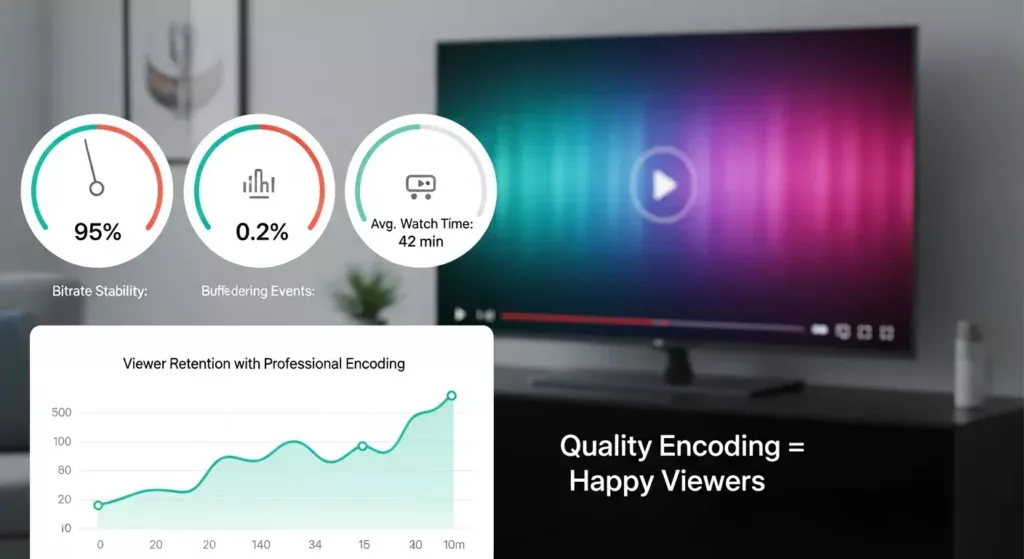
Encoding quality directly determines viewer behavior in ways traditional metrics often miss. Research shows buffering events lasting longer than 2 seconds cause 20% of viewers to abandon streams, while three consecutive buffering instances trigger 40% abandonment. An IPTV Encoder Box outputting unstable bitrates—caused by improper encoding presets or insufficient processing power—creates exact conditions driving this buffering behavior.
Bitrate consistency matters more than peak values. A professional encoder box maintaining 4 Mbps with less than 5% variance delivers superior viewer experience compared to fluctuating between 3-6 Mbps. Network equipment and IPTV middleware handle consistent streams efficiently, but variable bitrates cause buffer management conflicts manifesting as playback stuttering regardless of available bandwidth.
Video compression artifacts reduce perceived quality even when resolution remains high. Low-quality H.264 encoder implementations produce blocking artifacts during high-motion scenes that viewers immediately notice. Professional IPTV hardware encoders implement advanced motion estimation algorithms preserving edge detail and minimizing blocking. Watch time metrics reveal encoding impact—IPTV services with stable encoding report 35-40% higher average viewing sessions compared to those experiencing frequent quality fluctuations.
Encoding Profiles, Presets, and Compression Strategy
Encoding profiles represent the architectural blueprint determining how your IPTV Encoder Box converts source video into distributable streams. The profile selection—Baseline, Main, or High for H.264, or Main/Main10 for H.265—affects compatibility, compression efficiency, and processing requirements. High Profile H.264 delivers 10-15% better compression than Baseline but requires more capable set-top boxes.
GOP (Group of Pictures) structure controls how encoders balance compression efficiency with seek-ability and error resilience. Live broadcasts benefit from 1-2 second GOP lengths (30-60 frames at 30fps), enabling quick channel switching and minimizing corruption impact, while on-demand content tolerates 4-6 second GOPs for improved compression.
Frame interval settings determine I-frame frequency, directly impacting bandwidth and stream robustness. More frequent I-frames increase bandwidth 15-25% but improve error recovery and channel switch speed—critical for IPTV services where viewers frequently browse channels. Hotels and hospitality IPTV particularly benefit from 1-second I-frame intervals despite higher bandwidth, as guest satisfaction with channel switching speed outweighs bandwidth costs. Bitrate ladder strategy for adaptive streaming requires careful encoder configuration or multiple encoder deployment, typically including 1080p at 4-6 Mbps, 720p at 2-3 Mbps, and 480p at 1-1.5 Mbps, ensuring viewers on varying connection speeds receive optimal quality.
Variable bitrate (VBR) versus constant bitrate (CBR) encoding presents trade-offs between quality efficiency and network predictability. VBR encoding optimizes quality by allocating more bits to complex scenes, reducing average bandwidth by 20-30% while maintaining quality. However, IPTV distribution over multicast networks often requires CBR to prevent network congestion, as switches and routers handle constant traffic more reliably than variable bursts during action-heavy content segments.
Network Optimization for IPTV Encoder Box Deployments
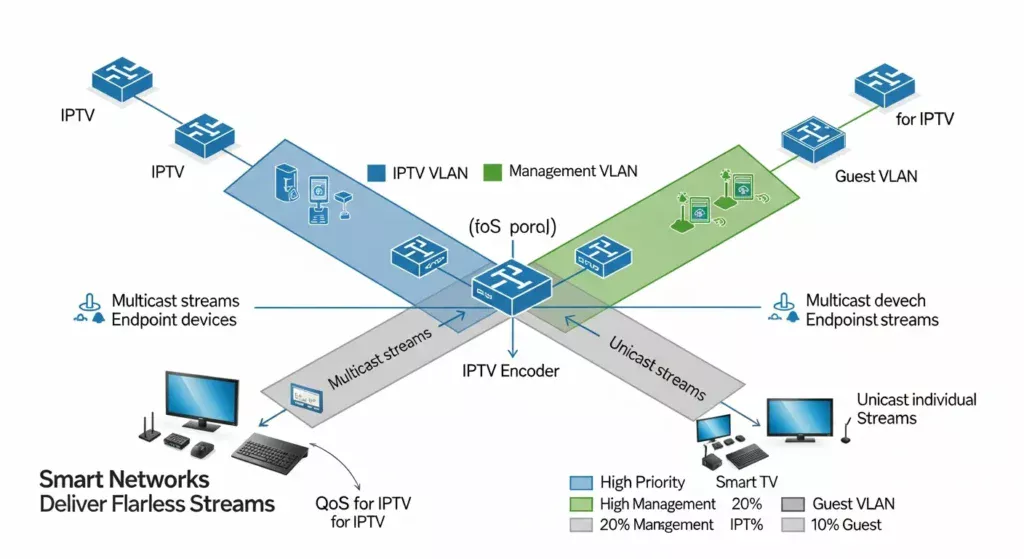
Network architecture determines whether your IPTV Encoder Box output reaches viewers reliably at scale. Multicast distribution versus unicast delivery represents the fundamental design choice. Multicast sends one stream copy to many receivers simultaneously, efficient for delivering identical content to hundreds on the same network—ideal for hotel IPTV, corporate campuses, or healthcare facilities. Unicast creates separate streams for each viewer, essential for internet delivery but consuming N times bandwidth where N equals concurrent viewers.
VLAN segmentation isolates IPTV traffic from general network data, preventing bandwidth competition and Quality of Service conflicts. Dedicating VLANs to IPTV streams allows priority queuing and bandwidth reservation guaranteeing encoder output reaches distribution servers without interference. Quality of Service (QoS) policies mark IPTV packets for priority handling across network switches. Configuring DSCP values ensures encoder output receives preferential treatment during congestion.
Latency management across the network path accumulates delay at each hop. Encoder processing contributes 50-200ms, network transit adds 10-50ms per switch/router hop, and server processing adds another 100-300ms before streams reach viewers. For low-latency IPTV applications, minimizing network hops and selecting encoders with hardware acceleration becomes critical to maintaining sub-second glass-to-glass latency.
IPTV Encoder Box Compatibility with Middleware & Portals
IPTV middleware integration determines operational efficiency and feature availability for resellers and platform operators. An IPTV Encoder Box must output stream formats and protocols that your middleware can ingest without transcoding. Common middleware platforms—Xtream Codes successors, Ministra, Stalker Portal—expect specific input formats, typically UDP multicast for local distribution or RTMP/RTSP for internet delivery. Encoder-middleware format mismatches force intermediate transcoding adding latency, consuming server resources, and creating additional failure points.
EPG (Electronic Program Guide) integration requires encoders supporting metadata injection or middleware capable of overlaying guide data onto encoder streams. Professional encoder boxes with API support allow automated channel lineup updates, ensuring EPG information matches actual stream availability. Manual EPG maintenance becomes unsustainable beyond 20-30 channels, making API-driven integration essential for scaling IPTV operations. Recording and time-shift functionality depends on encoder output format consistency—stable bitrates and predictable keyframe intervals enable clean recording segmentation without artifacts during playback.
Custom portal development often requires specific encoder output characteristics. Web-based IPTV portals using HLS streaming need encoders generating segmented .ts files and .m3u8 playlists, while native app portals might consume UDP streams directly through VLC-based players. Verifying encoder output compatibility with your chosen portal technology before purchase prevents costly redesigns or equipment replacement later.
Multi-server distribution architectures use encoder outputs as origin streams that multiple middleware instances replicate. An IPTV Encoder Box feeding streams to geographically distributed servers enables CDN-like architectures where regional middleware instances serve local viewers, reducing backbone bandwidth and improving redundancy.
Scaling from One Channel to Hundreds
Horizontal scaling strategies for IPTV infrastructure determine growth feasibility and operational complexity. Starting with single-channel deployment validates workflows and revenue models before capital investment in multi-channel capacity. An initial IPTV Encoder Box handling 1-4 channels establishes baseline encoding parameters, network integration patterns, and middleware compatibility informing larger deployments.
Growth planning requires understanding encoder capacity limits. Professional IPTV hardware encoders typically handle 1-16 channels depending on resolution and compression settings. A 4-channel 1080p encoder might support 8 channels at 720p or 16 channels at 480p, providing scaling flexibility through resolution adjustment. Planning channel expansion requires calculating whether reducing resolution maintains acceptable quality for your content type—news broadcasts tolerate 720p well while sports content suffers noticeably. Redundancy architecture prevents single points of failure as channel counts grow. Deploying encoder pairs in active-passive configuration ensures channel availability during hardware failure. A 50-channel deployment might use 7 eight-channel encoder boxes with one spare, allowing hot-swap replacement without service interruption.
Load balancing across multiple IPTV Encoder Box units distributes processing and network load while enabling incremental capacity addition. Rather than deploying one 32-channel encoder, using four 8-channel encoders provides granular scaling and isolated failure domains. Future-proofing involves selecting encoders with upgrade paths and format flexibility. H.265/HEVC support becomes essential as bandwidth costs increase, preventing equipment obsolescence.
IPTV Encoder Box Security & Stream Protection
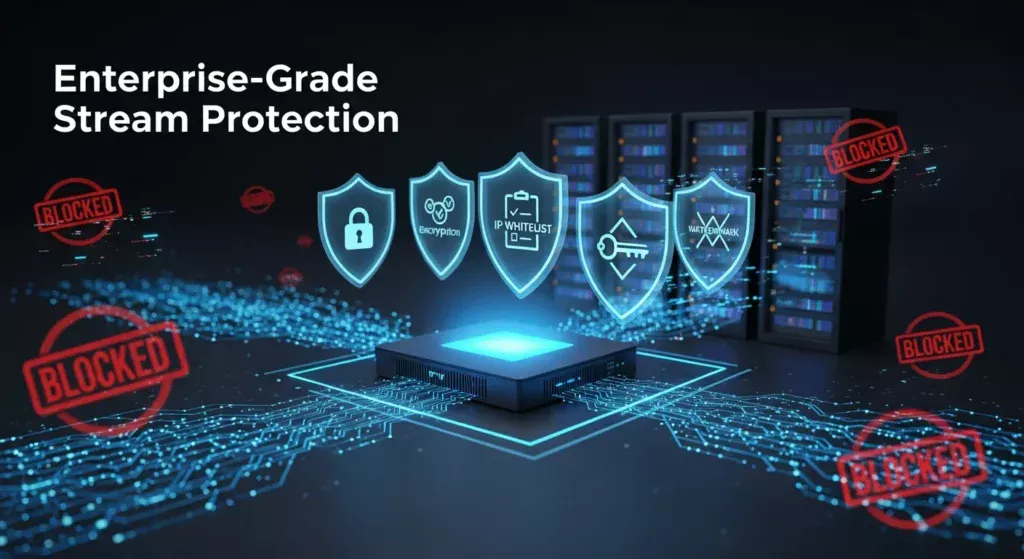
Stream security begins at the encoding layer where unauthorized access prevention determines revenue protection and content compliance. An IPTV Encoder Box with IP whitelisting restricts stream output to authorized middleware servers exclusively, preventing stream URL sharing enabling piracy. Configuring encoder output to accept connections only from known server IP addresses creates the first barrier against unauthorized distribution.
Access control through encoder authentication requires middleware to present valid credentials before receiving streams. Professional encoder boxes support username/password authentication or token-based access, ensuring only authorized IPTV portals can retrieve content. Encryption at the encoder level protects streams during transit from origin to distribution servers using AES standards, preventing packet capture attacks extracting unencrypted content from network traffic.
Stream watermarking capabilities embed viewer identification into video content, enabling piracy source tracking. Advanced IPTV hardware encoders support forensic watermarking surviving screen recording and re-encoding, allowing content owners to identify which subscriber account leaked protected content.
Power Consumption, Heat Management & 24/7 Stability
Hardware efficiency determines operational cost and reliability for continuous IPTV operations. A professional IPTV Encoder Box consumes 20-60 watts depending on channel density and encoding complexity, translating to $15-50 annually in electricity costs per encoder. Heat management directly impacts component longevity and failure rates. Encoders running continuously at 70-80°C internal temperatures experience 40-50% shorter component lifespans compared to those maintaining 50-60°C through adequate cooling.
24/7 uptime requirements demand encoders designed for continuous operation rather than consumer equipment repurposed for IPTV. Industrial-rated IPTV hardware encoders specify MTBF ratings of 50,000-100,000 hours. Environmental considerations affect encoder placement—temperature fluctuations in poorly climate-controlled equipment rooms stress components through thermal cycling.
Monitoring and alerting systems detect degradation before complete failure. Professional IPTV Encoder Box models with SNMP support integrate with monitoring platforms tracking temperature, fan speed, and encoding performance metrics, enabling preventive maintenance avoiding service interruptions.
When an IPTV Encoder Box Is NOT the Right Choice
Honest assessment reveals scenarios where dedicated encoder hardware creates more problems than it solves. Single-channel operations with limited growth plans often achieve better economics through cloud encoding. The upfront $800-2,000 cost of a professional IPTV Encoder Box requires 12-24 months to amortize compared to cloud services costing $50-100 monthly.
Highly variable workloads favor cloud scalability over fixed hardware capacity. Event-based streaming—quarterly conferences, seasonal sports, or irregular broadcasts—leaves dedicated encoders idle 70-90% of time. Geographically distributed encoding requirements challenge hardware deployment. IPTV services needing presence in 5+ cities face multiplied hardware costs and maintenance complexity.
Limited technical expertise makes managed cloud services attractive despite higher costs. IPTV Encoder Box deployment requires networking knowledge and troubleshooting capabilities that smaller operations may lack.
Buying Checklist: Choosing the Right IPTV Encoder Box
Strategic evaluation criteria guide IPTV Encoder Box selection beyond feature checklists and price comparisons:
Channel capacity planning: Calculate current channel count plus 18-24 month growth projection. Purchasing an encoder at 90% capacity limits growth flexibility. Target 60-70% initial utilization allowing expansion without immediate additional investment.
Codec support verification: Confirm H.264 as baseline with H.265/HEVC strongly preferred for bandwidth efficiency. Verify middleware compatibility with selected codec—some older IPTV portals lack HEVC support.
Output protocol matching: Ensure encoder supports protocols your IPTV middleware requires. UDP multicast for local networks, RTMP for internet streaming, and HLS for mobile delivery represent common requirements.
Input connectivity assessment: Count HDMI, SDI, and composite inputs needed for your source devices. Broadcast environments prefer SDI for professional cameras, while hotel IPTV typically uses HDMI from set-top boxes.
API and automation support: Evaluate whether encoder configuration, monitoring, and control via API enables operational automation. Manual configuration across multiple encoder boxes becomes unsustainable beyond 5-10 units.
Reliability indicators: Request MTBF specifications, warranty terms, and replacement availability. Professional IPTV hardware encoders specify 50,000+ hour MTBF with 2-3 year warranties.
Security feature validation: Confirm IP whitelisting, authentication support, and encryption capabilities align with content protection requirements. Premium content delivery necessitates robust security features.
Conclusion
Strategic IPTV Encoder Box deployment separates thriving IPTV operations from failing ones. Success requires understanding that encoding is not a commodity function but foundational infrastructure determining service quality, operational costs, and scalability potential. Whether operating a single-channel church broadcast or managing hundreds of channels across hotel properties, encoding decisions ripple through every aspect of viewer experience and business viability.
Ready to optimize your IPTV delivery? Choose the right IPTV Encoder Box and build a streaming infrastructure that scales. Share your experience in the comments or subscribe for advanced IPTV guides.
Frequently Asked Questions
How does an IPTV Encoder Box affect IPTV scalability?
An IPTV Encoder Box establishes the foundation for scalability by determining channel capacity, output format flexibility, and integration capability with IPTV middleware. Encoders with multi-protocol output and API support enable horizontal scaling through multiple encoder deployment while maintaining operational manageability. Selecting encoders handling 4-8 channels allows granular capacity addition as demand grows, preventing overprovisioning waste or capacity constraints limiting growth.
Can one encoder feed multiple IPTV servers?
Professional IPTV hardware encoders output streams that multiple middleware servers can simultaneously ingest, enabling distributed architectures. UDP multicast naturally supports many receivers, while RTMP and HLS outputs can feed multiple servers if the encoder has sufficient network bandwidth. This capability allows geographically distributed IPTV infrastructure where regional servers receive identical origin streams from centralized encoders, improving redundancy and viewer latency.
Is multicast always better than unicast?
Multicast excels for local network distribution where many viewers watch identical content simultaneously, reducing bandwidth consumption proportionally to viewer count. However, multicast requires network infrastructure configuration—IGMP snooping, multicast routing—adding complexity. Unicast delivers superior reliability across the internet and heterogeneous networks where multicast support is inconsistent. Hotel and corporate IPTV benefit from multicast, while internet-based IPTV services require unicast or adaptive streaming protocols like HLS.
How do encoder settings impact IPTV buffering?
Encoder bitrate stability and GOP structure directly affect buffering behavior. Variable bitrate encoding exceeding network capacity during complex scenes causes buffer depletion and playback interruptions. Improper GOP length creates large I-frame bursts momentarily saturating links, triggering buffering. Professional IPTV Encoder Box configuration maintains bitrate consistency within 5-10% variance and balances GOP length to distribute bandwidth demand evenly, preventing buffering events driving viewer abandonment.